

Background photo: historyfacts.com
The reality would be a bit different, sorry to ruin your dreams (and mine too, to be honest). It would be more like dancing nonstop until you start feeling extreme hunger and thirst, or until your feet are raw… and you die. Sorry, I do not mean to be morbid, but that is exactly the situation.
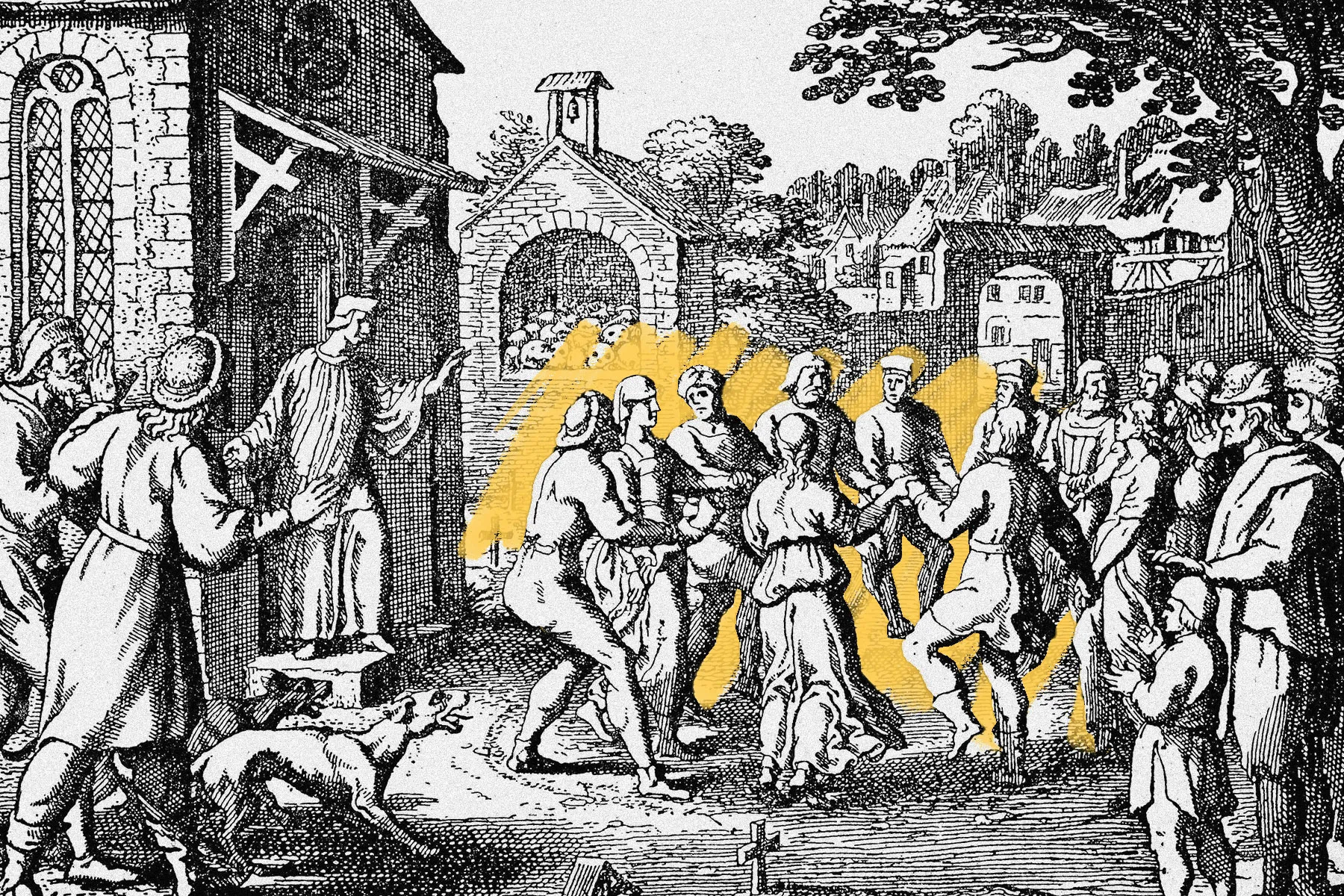
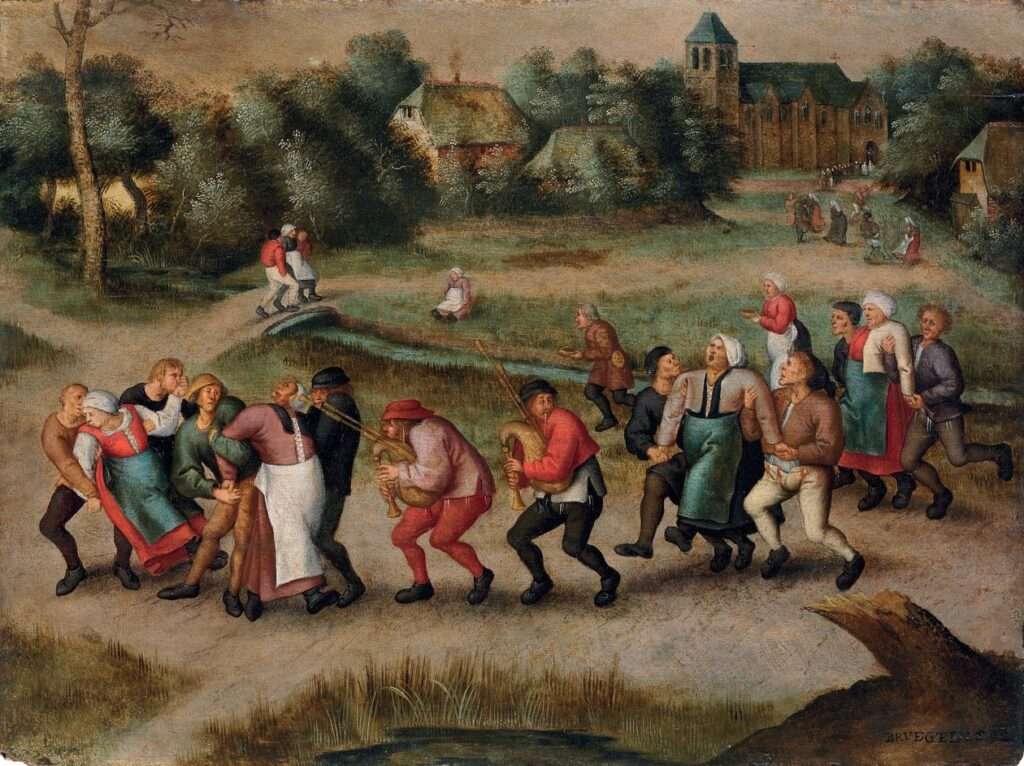
In 1518, a mysterious outbreak of choreomania took over the city of Strasbourg, France. The case began in July with a woman named Frau Troffea; she simply started dancing in the middle of the street, moving uncontrollably, alone, and without stopping.
But so far, what is the problem? It is not like we do not feel the same when listening to our favorite music on the way home. However, this time it was different: the woman not only did not stop, but she also seemed to be in some kind of trance.
Within a week, over 30 people were following the same path (or choreography?), and in less than a month there were hundreds, as if they had somehow been “infected.” Immense efforts were made to stop what was happening, ranging from prayers and processions to the brilliant idea of playing music while people danced, which actually made the situation worse, as the music encouraged even more people to join in (can we blame them? I do not know what I would do if I suddenly found myself surrounded by hundreds of people dancing nonstop, maybe… Rihanna?).
Another measure taken was to bring people to the Sanctuary of St. Vitus, the patron saint of dancers and epileptics, located in the nearby mountains of Saverne. Due to the strong religious influence in Europe at the time, the main theory was that this entire episode was a form of divine punishment; prayers were said, and amulets were placed on people’s feet in an attempt to end the possession.
However, another theory, strongly supported by doctors at the time, claimed that it was caused by overheating of the blood, which allegedly bubbled inside people and forced them to dance. Unfortunately, the lack of scientific knowledge led to suffering, as people were subjected to procedures like bloodletting to „cool” the body, cold baths, or confinement in dark spaces.
To this day, sources are scarce when it comes to determining the exact number of people who tragically died, whether from exhaustion, stroke, or even heart attacks brought on by the plague. It is estimated that approximately 400 people were affected (Walker, J. [2008]. A Time to Dance, a Time to Die: The Extraordinary Story of the Dancing Plague of 1518. Icon Books). Among the dead, regional chronicles estimate “between a dozen and several dozen,” while other sources simply report that “many died.”
There is no information about affected children, so we can assume that most participants were adults. According to an article on Bygonist (2023), the majority were women, though many sources do not specify gender.
Today, the cause of this phenomenon remains unknown; however, there are several theories – and I will focus on the two main ones. The first suggests that this phenomenon may have been a case of mass hysteria. But what exactly is that? According to Wentao Yan (2023):
“There is a common consensus among researchers that mass psychogenic illness is classified as a social phenomenon that strikes otherwise healthy groups and that it often occurs in people who have experienced and are experiencing high levels of psychological, social or political oppression” (p. 151).
Analyzing the society of the time, we find several factors that could have contributed to this hysteria. Economically, it was a period marked by famine and poverty. Nothing favored prosperity: the fields struggled to withstand the low temperatures of the so-called Little Ice Age, which severely damaged crops, and the devastation caused by the Black Death in the 14th century had left significant gaps in the workforce; health conditions had not improved, and other plagues continued to emerge. Even if they were not as fatal as the Black Death, the population still declined.
Socially, Europe was also going through a difficult period. Due to the hierarchical system, the gap between classes was extreme. The lower classes faced long hours of work and generally poor living conditions. The lack of knowledge in health and science was also a major obstacle, pushing people to seek spiritual explanations and hope.
These factors, clearly, could lead to mental illness and extreme dissatisfaction, resulting in mass hysteria. People were exhausted, weary from work, starving, and taking orders until the end of their short lives.
Another theory is poisoning caused by bread contaminated with a fungus scientifically known as Claviceps purpurea:
“Claviceps purpurea is a parasitic fungus that infects cereals, particularly rye, and produces ergot alkaloids, including lysergic acid and its derivatives. These compounds have historically caused episodes of mass poisoning in medieval Europe when grain stocks were contaminated by the fungus” (according to the definition on ScienceDirect), better known for its similarity to LSD:
“The neurobiological significance of Claviceps purpurea is underscored by its synthesis of neuroactive compounds such as ergotamine and lysergic acid diethylamide (LSD). LSD, derived from ergot alkaloids produced by this fungus, profoundly affects the nervous system, inducing vivid visual hallucinations, synesthesias, and alterations in thinking and time perception” (ScienceDirect).

Although plausible, the problem with this theory is that, without the morbid aspect, the situation would probably have resembled a rave, with many people dancing under the effects of LSD. However, in this case, the symptoms of the fungus (convulsions, hallucinations, and muscle spasms) would have appeared. Dancing is not exactly one of these symptoms, and it typically stops once contaminated bread is removed (Saskatchewan Agriculture, 1999)), which was not the case here, as the outbreak lasted for weeks.
We do not know the true cause, and I have little hope that we will find out soon, even with the enormous advancement of science. Nevertheless, it is incredibly curious and fascinating how it all happened. It was certainly a tragedy, but it also makes us reflect on how inexperienced we still are when it comes to understanding human behavior. Even with thousands of studies, we remain an enigma, and we truly do not know what might happen tomorrow.
There are several artistic interpretations of this event – from music, such as Dance Fever, the fifth album by the British band Florence + The Machine, to literary works, such as Kiran Millwood Hargrave’s novel, The Dance Tree. Feel free to explore the mysteries of this event from an artistic perspective as well.
So, until science reveals the true cause, let us hope that when we see someone dancing in the street, it is not a plague, but a form of expression, whether of joy or another feeling. And let us ask ourselves: if, in our modern society, God made us dance this way as punishment, how long could we continue?